You Have Entered an Invalid Address Please Check Your Entry and Try Again Paypal
Why Won't My Address Verify / Validate?
USPS Doesn't Recognize My Accost!
For an address to be valid, it must lucifer a corresponding address in the official USPS accost database which tin can be accessed through the USPS APIs. If an accost contains any incorrect data, it will non match a corresponding accost in that database, and is therefore "invalid". Sometimes, an address will not validate because the accost is marked as "vacant" by the USPS. Additionally, a new address, an unregistered address, or one located within a postal code primarily serviced by PO boxes, would all fail to validate. The all-time way to be sure an accost is valid is to verify the address before yous mail or send something.
Table of Contents:
- How to Perform Accost Validation
- Bad Addresses
- How Do I Get the USPS to Recognize My Address
- "Just UPS Delivered There; That Means It's Valid, Right?"
- What Practise I Do When an Accost is Invalid?
- Conclusion
How to Perform Accost Validation: A Detailed Guide
Some addresses won't verify because, for one cause or another, they're invalid.
It's a painful truth, and it happens to the best of us. You think you're being smart. You think you're taking all the right steps, and validating your addresses before you effort to ship something. And and then, the unthinkable happens: Your address is invalid.
But in that location are logical explanations for events like these, and nosotros can all find peace by seeking to sympathize the "why" of our situation. In other words, if y'all want to know what to do or how to fix information technology, y'all accept to know what broke showtime. And before you lot tin can do that, y'all demand to know what information technology's supposed to wait like when it does work.
Accost Validation
Address validation (ofttimes called accost verification) is the process of checking to see if an accost is existent. And information technology's a simple procedure; explaining it is every bit easy as one-2-3:
- Accost Standardization and Parsing
- Checking the Database
- Returning a Value
Allow'south await at how to use the Smarty (formerly SmartyStreets) address verification API to perform these steps.
Step 1: Address Standardization and Parsing
First, a submitted address is standardized. This means that whatsoever incorrect formatting is rectified. House number, street name, city, etc. are all organized, spelled, and abbreviated correctly, according to the official standards of the postal system that the address belongs to. In the Us, for example, "Street" is changed to "St.", "Utah" is inverse to "UT," house numbers are listed before street names, and so forth. This is washed so that the address tin can be properly matched against USPS address validation.
During this footstep, other modest errors are also corrected. Misspelled street or urban center names are stock-still, and missing information is filled in. This tin can only go so far, however—in that location'southward niggling that standardizing tin can do if the given accost lists the wrong street proper noun, or if the street proper name is missing. Urban center names are possible if the postal lawmaking and street address are correct. Likewise, a missing or wrong street designation can be fixed, as long as in that location's not more than ane street with that name in the city.
Here's an instance of a right address:
2116 Beresford Rd., Smallville, KS 67524 Now suppose that the same address had been submitted with some incorrect information or an incorrect format. Standardizing tin can fix things similar an incorrect street designation, misspelled city, or missing ZIP Lawmaking, provided information technology has enough other information for context:
2116 Beresford St., Smllvile, KS (Incorrect street designation, misspelled urban center)
Information technology can't fix things like an incorrect street address or urban center name, or an incorrect city or state proper name if the postal lawmaking is missing:
2115 Hartford Rd., Smallville, KS 67524 (Wrong address number, wrong street name)
In short, if it can identify what information technology should be, then it can make the correction, but without the proper context clues the address is just wrong. Which leads us to the other half of stride 1: parsing. Address parsing in full general is an effort to disassemble a line of data, identify its singled-out parts, and label them. This is a technique frequently practical to accost validation, every bit it helps make both the standardizing and validating steps more than effective.
Properly identifying the moving parts of an address can make it possible to fill in or correct more data that would normally be possible with standardization lone. This ways there's a amend risk of your accost validating, even if you wrote some of it downward wrong.
Similar standardizing even so, parsing is not foolproof; parsing often runs into little hiccups, like when trying to differentiate betwixt
123 Bedford St., Martin, Colorado and
123 Bedford, St. Martin, Colorado where the beginning accost lists "Bedford Street", and the 2d lists "Saint Martin city", with the problem words abbreviating to an identical "St."
Parsing is usually washed in conjunction with standardizing, though a few validation providers do information technology every bit a terminal step after validation.
Footstep ii: Checking the Database
Once address cleansing has been performed and properly labeled via standardization and parsing, it'due south then taken and compared against a relevant database. The database used is the one that'southward the authoritative standard for whichever postal arrangement y'all're using. Usually that database is the one kept past the postal organization run by that nation'south government, like the USPS in the United States. A search is made to see if the address in question is on the official list, and if information technology is, it "validates", and is marked as a real, active address.
Failure to validate is the focus of this commodity, merely the many different "whys" deserve their ain explanations, so nosotros'll circle dorsum to it in a little bit. The short respond is that any address non listed in the database doesn't exist as far as the postal system is concerned, and then information technology'southward marked "invalid."
In practice, sometimes you lot aren't validating an address in order to mail a letter or package. Instead, you just need to know that the address is real. This occurs frequently in the procedure of merging and managing client databases. Since the USPS merely includes addresses that they evangelize to and since in that location are millions of addresses where the USPS doesn't offering door delivery, Smarty starts with the USPS address database and then adds additional public and private sources to give broader coverage. When an address validates that didn't originate from the USPS database, nosotros will tell yous so.
Taking this approach, allows you to validate addresses for shipping purposes just likewise for database management or annihilation in betwixt.
Step 3: Returning a Value
Last, the address data is returned to the user, complete with a valid/invalid status. This is accompanied by, if the validator provides it, an explanation of why it didn't validate or what part of the address failed to validate.
The response a validation provider returns to you may also include any supplemental information that the provider compiles regarding addresses that are submitted to them. Many providers include things like geocodes that correspond to the address, RDI labels, or time zone data. This supplemental information can range from nonexistent to exhaustive, depending on the visitor providing it.
This concludes our tour of the address validation process.
Bad Addresses
Now for the fun part. Addresses go wrong and fail to validate for a number of reasons, and then while this is not an exhaustive list, what we've put together hither is thorough. The following list should embrace only most every problem you're likely to experience.
Input Error
Never underestimate the power of humans messing upward. Mistakes in the style the data is input, if non screened, frequently go unnoticed until much later. But even if you lot're keeping an middle out for them, you're yet going to run into entries that are typed in incorrectly. Severe misspellings, flipping or scrambling numbers in the street address or the postal lawmaking—a little slip of the primal like that can crusade your address to be invalid.
Incorrect Information
Similar to the above reason, sometimes information is just inaccurate. A wrong street proper noun is put in, or city name, or postal code. Basically, any inaccuracy likewise severe for standardization to correct will make the address invalid.
Missing Information
Sometimes the problem is not that information is wrong, sometimes the problem is that the information is missing. It's really hard to validate an address if y'all don't know the house number or street name. Yous'll be able to verify the accuracy of the city/country/postal code relationship, simply without the actual location of the destination, yous're up a creek.
Falsified
On occasion, data is faux. People might falsify an address to hide an identity or steal ane, or to sign up for duplicates of things (among other reasons). Whatever the example, the falsification of information tin can crusade an accost to come back with an "invalid" result (or worse, you might be accidentally validating someone else's accost, without knowing it).
Not Serviced
Sometimes the postal service you lot're validating confronting doesn't service an area directly. Everything from PO box–only Nil Codes in the Usa to war-torn areas in a third-world state, in that location are just some places where the postman doesn't make house calls. If the physical accost is not receiving mail, it means that it won't be registered in the database, and that means any mail addressed to information technology volition be sent dorsum where it came from.
Non Registered
Regardless of which state or what post you're dealing with, an address needs to sign up with that mail if information technology's to receive any mail. It'south not the postal organisation'southward job to keep track of every available address that exists. It's their chore to continue runway of which addresses want mail service. If you lot don't speak up, they assume yous either don't want it or don't exist (see below). In either example, they won't exist giving VIP status to an accost that's not on the list.
New Address
Similar to unregistered addresses, a new address may non nonetheless have had time to sign up for mail, or perhaps the postal service system is nevertheless processing and calculation them to the list. The postal service isn't keeping track every time a new house or building springs up out of the ground; that burdens on you. If you occupy a new construction, and you want to exist receiving mail service, information technology's your job to make certain the post office is enlightened of your presence. Failure to practice and then will result in an invalid accost.
Unoccupied
If no one is using the address, in that location's no ane to sign the address upwards, and then information technology's not on the list.
Does Not Exist
Every now and again, you're looking at an accost that doesn't exist. Sometimes it'due south an address that'southward recently been condemned, demolished, or otherwise no longer in employ. More often, information technology'due south considering the accost never existed in the starting time place. No one has a use for an imaginary address. The post office has no use for information technology, you lot have no use for it. So a validation of the address volition but tell you that it can't find the address, making it invalid.
How Do I Get the USPS to Recognize My Accost
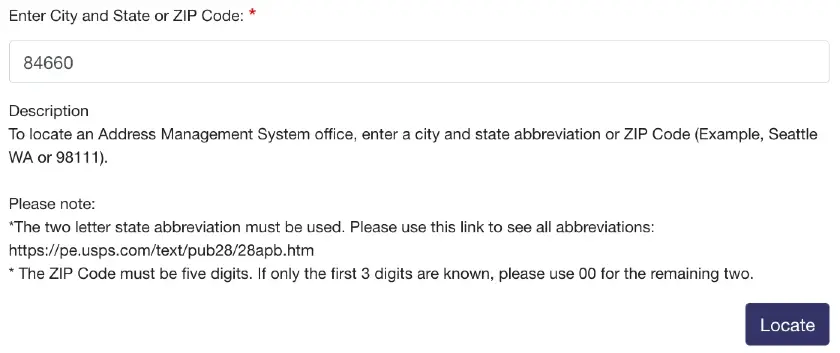
Getting the United States Postal service to recognize your address doesn't need to exist difficult but it may accept a few months to take event. So, the sooner you lot get started the amend. Addresses managed by the United states of america Accost Management System (AMS) allows the public to submit accost changes. You can find your local AMS part past entering your city and state or Cipher Code here.
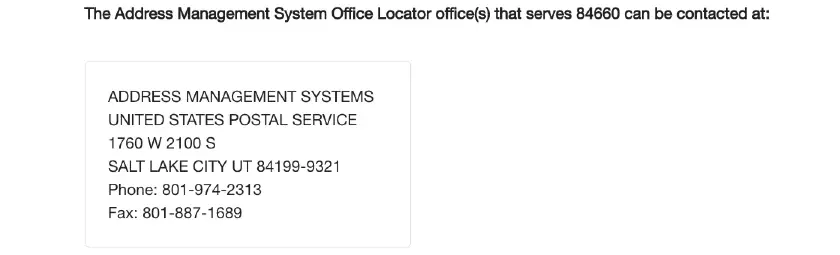
Y'all will then be provided with the address and phone number of your local AMS role who is in charge of your address. They will be able to aid yous in getting your address added or corrected with their organisation.
"Only UPS Delivered There; That Means Information technology'south Valid, Right?"
You lot may be enlightened that private carriers like UPS, FedEx, and DHL volition evangelize to locations not recognized as valid in the authoritative databases maintained by organizations like USPS. If so, you're probably wondering what that means. Practise they take their own database, and is it more accurate? Is there something wrong with the administrative database? How do the private carriers become away with aircraft to these aberrant addresses?
Individual carriers market themselves on their willingness to go places that the primary carrier won't. Often, they'll even comport objects and substances that carriers similar USPS won't bear upon. Only that doesn't mean they're amend, or that the addresses they deliver to are "valid" in the truest sense. Here's a few examples:
- Concrete location delivery for addresses serviced by PO boxes—because private carriers don't have whatsoever control over PO boxes, they tin can't evangelize at that place. Instead, they make home deliveries, bringing the postal service or package to the physical location as if that had been the mailing address all along. Since information technology's remote places where this tends to exist a problem, and dwelling commitment is required, your shipping costs volition likely be college to adjust for the extra work they'll have to do.
- Commitment to locations that don't/can't receive mail—places similar warehouses that don't have a place for usually delivering things similar letters and pocket-sized packages. Nether these weather condition, it'southward ordinarily larger objects that are shipped, and the private carrier is serving a office similar to a cargo shipping company. Because these are special locations, and because larger objects often require larger delivery vehicles and special tools for use in delivery, it tin can cost extra.
- Addresses not registered/exterior the service area—private carriers are also willing to get simply about anywhere there's someone to receive mail service. From the doomsday planner that wants to live off the grid, to the Inupik tribe on a remote island in Alaska, private carriers boldly go where no mailman has gone before. Merely that kind of trailblazing means going out of the way and, you lot guessed it, that makes it cost more.
You might call back information technology's bully that a private carrier tin become to all these magical and exotic places. Simply by definition, if they're delivering to places that aren't valid, that means y'all tin simply ship via private carriers (who, you know, cost more).
Now it bears mentioning that courier services like UPS and FedEx sometimes accept their own address validation tools, but you should know that at least in their case, not all validation is created equal. These tools don't validate in the truest sense, they just tell y'all whether they would be willing to take your package to the location to see if information technology's existent. And we have to tell you, shipping a package is a terrible way to validate an address.
For instance, the UPS validating tool but covers the 50 Us states, and information technology excludes armed services and diplomatic post office destinations. Those are valid addresses that are serviced past the USPS on a regular footing, and UPS can't tell you that they're real.
Likewise, the FedEx tool lacks some of the accuracy of more reliable validation, like the USPS address validation tools that we provide. For instance, it uses AVS to help fill up in missing information, since information technology doesn't standardize. As for the actual validation, rather than comparing the address against an authorized listing, The FedEx system just checks to see if the given address matches a existent state, city, and street, then checks the house number to run into if it falls within the available ranges on that street. If it does, information technology "validates" to FedEx standards.
That means FedEx is potentially validating the address to imaginary homes and businesses, and that you might not know your shipment isn't going to be delivered until you lot get a box in the mail with a "Return to Sender" sticker on it. They probably don't listen, since they go paid either way, just nosotros're betting that you do.
Here's where the discrepancy comes from, using the United states of america every bit an example: private carriers are not maintaining a separate postal system. They are using a system that is already in place—a system established and maintained past their competitor, USPS. They're not aggregating and keeping their own database of addresses. All they're doing is delivering things.
This is why we employ authoritative databases when we validate. Though private carriers tin reach locations that the databases say don't exist, they tin can't be counted on to tell you when an accost is real and few, if any, offering international validation (and we can just imagine the fun of an international package being returned to sender). What is international address validation ?
What Exercise I Do When an Address is Invalid?
For some causes of invalid addresses, at that place'south zero y'all tin can exercise. For starters, if someone falsified accost information, then there is little y'all can practise to track down the correct information. Merely if the problem was that someone mashed the keys when typing it in, or there was a mutual mistake in names of places, a human bear on can oftentimes resolve what a computer finds impossible. So here are a few ideas on coping with bad addresses.
Double check your data: perhaps at that place'south something you lot've missed. Peradventure a mistake was made at some point during entry, or something didn't copy properly. It never hurts to give information technology a second look.
Look for common errors: reversed numbers, commonly misspelled words, checking for authentic street designations, you know, the trivial things. The kinds of things that you might not think much of, but that the postmen and women need clarification on, if they're going to go the postal service to the right place. Equally humans, we're creatures of habit, and amid our habits are habitual errors. And so give the address a await-over, and check for the things yous get wrong once more and once again.
Is your address really a PO box?: It may exist a real address, but if that firm or business is part of a "postal service part box only" postal expanse, y'all're not going to get a solid validation on it. And then check and come across if you're testing an address that won't exist registered with the postal system due to the local service structure.
For The states addresses, in that location are a number of tools that tin practice this for you lot. In fact, nosotros can exercise information technology, and information technology won't cost you a dime. Only plug in the metropolis, state, and 9 digit ZIP Code into our address verification demo and we'll give y'all a quick breakdown of the ZIP Code, including its "type." If the type is "Due south" (for "standard") and so your accost is just invalid. But if the type is "P" (for "PO box"), so you need to know the box number if you ever intend to get mail to those recipients.
Something else y'all should know: if you do know the PO box number (or call up you know it), yous tin can validate information technology, just like y'all would a physical address. It ways the same thing: it's a real address, and it's currently beingness used. Here, we can show you how to ship mail to a PO box
Fill up in missing data: Missing information can exist a real problem when y'all're trying to validate, so make sure you've filled in everything you can. The more than information you can give, the more accurate the validation will be. If yous're given an invalid response, double-check and make sure that you've supplied as much of the address as possible, and requite it another get.
Conclusion
"Invalid-ness" is a real trouble. If it hasn't affected you lot notwithstanding, information technology has probable affected someone you know. Every day addresses are coming upwards invalid, and if left untreated, packages and letters will exist returned to sender by USPS as an insufficient accost or another type of error. As with many things, the road to healing begins with prevention: validation can help you place problem addresses, and though non every invalid address tin can exist cured, you can find peace of listen in the cognition of which of your addresses are real.
And so remember, an invalid address has a reason. Those reasons can be the key making a successful endeavour at accost validation, if you know them. And knowing, afterwards all, is half the battle.
Source: https://www.smarty.com/docs/why-wont-my-address-validate
0 Response to "You Have Entered an Invalid Address Please Check Your Entry and Try Again Paypal"
Post a Comment